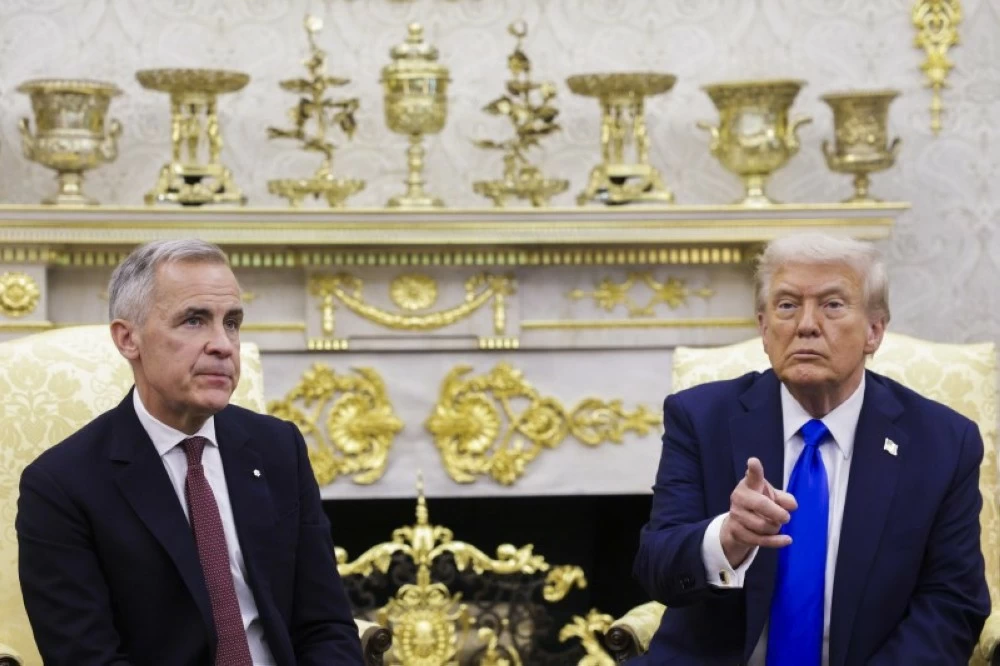

WASHINGTON — U.S. President Donald Trump on Saturday threatened to impose a 100% tariff on goods imported from Canada if Ottawa proceeds with a trade deal with China. In a social media post, Trump warned that if Canadian Prime Minister Mark Carney “thinks he is going to make Canada a ‘Drop Off Port’ for China to send goods and products into the United States, he is sorely mistaken.” The threat comes as Canada negotiates an agreement to lower tariffs on Chinese electric vehicles in exchange for reduced import taxes on Canadian agricultural products. Trump initially said the deal was something Carney “should be doing” and called it “a good thing for him to sign.” Canada’s minister responsible for trade with the United States, Dominic LeBlanc, said Canada and China had resolved “several important trade issues,” adding that Ottawa was not pursuing a free-trade agreement with Beijing. Trump’s comments followed an escalating war of words with Carney, amid tensions triggered by Trump’s push to acquire Greenland, which has strained relations within NATO. Speaking in Davos, Switzerland, earlier this week, Trump said “Canada lives because of the United States.” Carney rejected the remark, saying Canada could serve as an example that countries do not need to bend toward autocratic tendencies. “Canada doesn’t live because of the United States. Canada thrives because we are Canadian,” he said. Trump later revoked an invitation for Carney to join his proposed “Board of Peace,” which the U.S. president has said he is forming to help resolve global conflicts. Trump has repeatedly questioned Canada’s sovereignty, previously suggesting it should become a 51st U.S. state. He also posted an altered image on social media this week depicting Canada, Greenland, Venezuela and Cuba as part of U.S. territory. In his post Saturday, Trump referred to Canada’s leader as “Governor Carney,” a nickname he previously used for Carney’s predecessor, Justin Trudeau. Carney has emerged as a leading voice among middle powers seeking closer cooperation to counter U.S. pressure under Trump. Speaking in Davos, he warned that “middle powers must act together because if you are not at the table, you are on the menu,” citing coercion by major powers without naming Trump. He also warned of a lasting “rupture” between the United States under Trump and its Western allies.Trump said in a subsequent post that “China will eat Canada alive,” claiming Beijing would destroy its businesses and social fabric, before adding that such a takeover “is not going to happen.” Canada has not yet reached an agreement with Washington to ease tariffs imposed by the Trump administration on key sectors of its economy. However, the Canada-U.S.-Mexico Agreement has shielded Canada from the most severe measures. The pact is due for review this year. Canada had initially mirrored U.S. trade policy toward China by imposing a 100% tariff on Chinese electric vehicles and 25% tariffs on steel and aluminum. China responded with 100% import taxes on Canadian canola oil and meal and 25% duties on pork and seafood. As Trump intensified pressure tactics, Canada’s foreign policy has diverged from Washington’s, creating space for improved ties with Beijing. Carney announced the tariff adjustments earlier this month during a visit to China. Carney has said Canada’s relationship with the United States remains deep and complex, while acknowledging disagreements with China on issues including human rights. Canada is the top export destination for 36 U.S. states, with nearly $3.6 billion Canadian worth of goods and services crossing the border daily. About 60% of U.S. crude oil imports and 85% of U.S. electricity imports come from Canada, which is also the largest foreign supplier of steel, aluminum and uranium to the United States.WASHINGTON — U.S. President Donald Trump on Saturday threatened to impose a 100% tariff on goods imported from Canada if Ottawa proceeds with a trade deal with China. In a social media post, Trump warned that if Canadian Prime Minister Mark Carney “thinks he is going to make Canada a ‘Drop Off Port’ for China to send goods and products into the United States, he is sorely mistaken.” The threat comes as Canada negotiates an agreement to lower tariffs on Chinese electric vehicles in exchange for reduced import taxes on Canadian agricultural products. Trump initially said the deal was something Carney “should be doing” and called it “a good thing for him to sign.” Canada’s minister responsible for trade with the United States, Dominic LeBlanc, said Canada and China had resolved “several important trade issues,” adding that Ottawa was not pursuing a free-trade agreement with Beijing. Trump’s comments followed an escalating war of words with Carney, amid tensions triggered by Trump’s push to acquire Greenland, which has strained relations within NATO. Speaking in Davos, Switzerland, earlier this week, Trump said “Canada lives because of the United States.” Carney rejected the remark, saying Canada could serve as an example that countries do not need to bend toward autocratic tendencies. “Canada doesn’t live because of the United States. Canada thrives because we are Canadian,” he said. Trump later revoked an invitation for Carney to join his proposed “Board of Peace,” which the U.S. president has said he is forming to help resolve global conflicts. Trump has repeatedly questioned Canada’s sovereignty, previously suggesting it should become a 51st U.S. state. He also posted an altered image on social media this week depicting Canada, Greenland, Venezuela and Cuba as part of U.S. territory. In his post Saturday, Trump referred to Canada’s leader as “Governor Carney,” a nickname he previously used for Carney’s predecessor, Justin Trudeau. Carney has emerged as a leading voice among middle powers seeking closer cooperation to counter U.S. pressure under Trump. Speaking in Davos, he warned that “middle powers must act together because if you are not at the table, you are on the menu,” citing coercion by major powers without naming Trump. He also warned of a lasting “rupture” between the United States under Trump and its Western allies.Trump said in a subsequent post that “China will eat Canada alive,” claiming Beijing would destroy its businesses and social fabric, before adding that such a takeover “is not going to happen.” Canada has not yet reached an agreement with Washington to ease tariffs imposed by the Trump administration on key sectors of its economy. However, the Canada-U.S.-Mexico Agreement has shielded Canada from the most severe measures. The pact is due for review this year. Canada had initially mirrored U.S. trade policy toward China by imposing a 100% tariff on Chinese electric vehicles and 25% tariffs on steel and aluminum. China responded with 100% import taxes on Canadian canola oil and meal and 25% duties on pork and seafood. As Trump intensified pressure tactics, Canada’s foreign policy has diverged from Washington’s, creating space for improved ties with Beijing. Carney announced the tariff adjustments earlier this month during a visit to China. Carney has said Canada’s relationship with the United States remains deep and complex, while acknowledging disagreements with China on issues including human rights. Canada is the top export destination for 36 U.S. states, with nearly $3.6 billion Canadian worth of goods and services crossing the border daily. About 60% of U.S. crude oil imports and 85% of U.S. electricity imports come from Canada, which is also the largest foreign supplier of steel, aluminum and uranium to the United States.
Trump threatens 100% tariff on Canadian goods over China trade deal