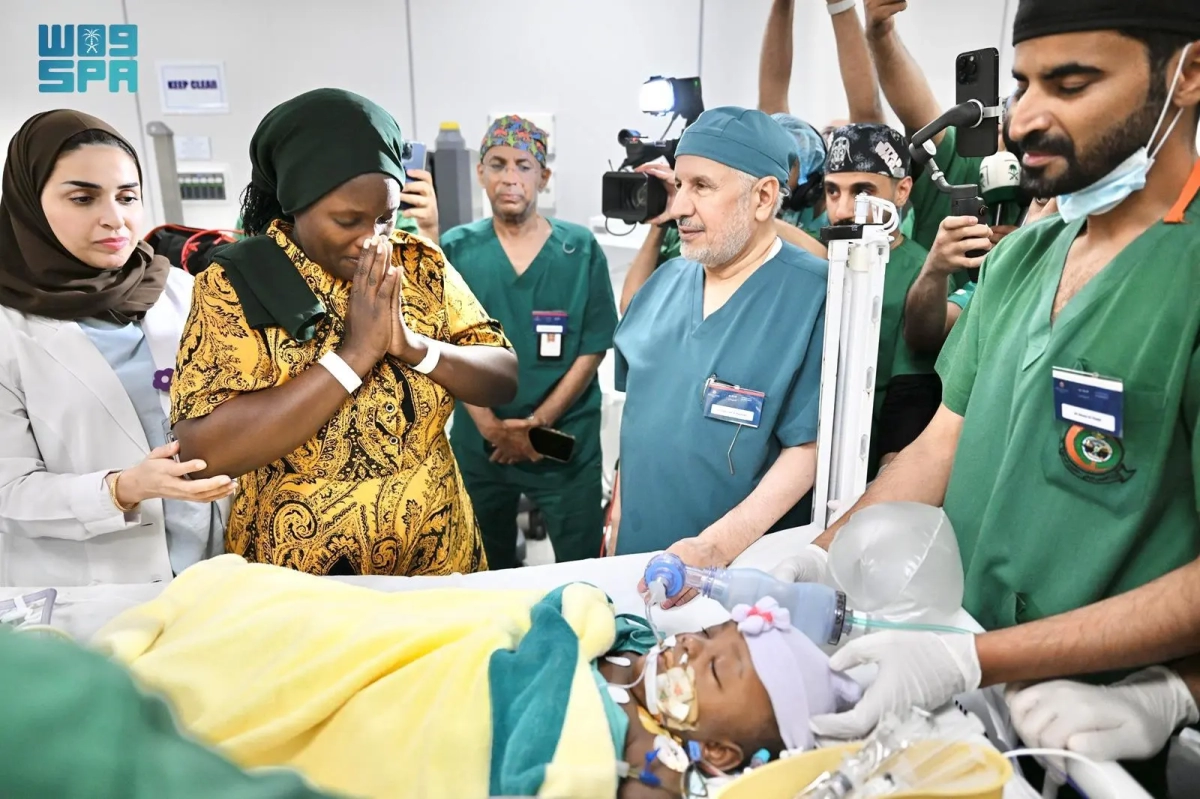
RIYADH — A specialized Saudi medical and surgical team successfully separated Tanzanian conjoined twins “Nancy and Nice” during a complex operation carried out at King Abdullah Specialist Children’s Hospital at King Abdulaziz Medical City in Riyadh.Supervisor General of King Salman Humanitarian Aid and Relief Center and head of the Saudi Conjoined Twins Program medical team Dr. Abdullah Al Rabeeah said the operation lasted 16 and a half hours and was completed across 10 stages.He said 35 consultants, specialists, nurses and technicians from multiple disciplines participated in the surgery, including pediatric surgery, anesthesia, plastic surgery, pediatric urology, and pediatric orthopedics.Al Rabeeah explained that the twins were joined at the lower chest, abdomen and pelvis, sharing parts of the liver, large intestine, urinary and reproductive systems, as well as a malformed shared lower limb.He noted that the procedure marks the third successful separation of Tanzanian conjoined twins and the 71st operation performed under the Saudi Conjoined Twins Program.The program, which has operated for more than 35 years, has reviewed 157 cases from 28 countries, reflecting Saudi Arabia’s leading humanitarian and medical role globally.RIYADH — A specialized Saudi medical and surgical team successfully separated Tanzanian conjoined twins “Nancy and Nice” during a complex operation carried out at King Abdullah Specialist Children’s Hospital at King Abdulaziz Medical City in Riyadh.Supervisor General of King Salman Humanitarian Aid and Relief Center and head of the Saudi Conjoined Twins Program medical team Dr. Abdullah Al Rabeeah said the operation lasted 16 and a half hours and was completed across 10 stages.He said 35 consultants, specialists, nurses and technicians from multiple disciplines participated in the surgery, including pediatric surgery, anesthesia, plastic surgery, pediatric urology, and pediatric orthopedics.Al Rabeeah explained that the twins were joined at the lower chest, abdomen and pelvis, sharing parts of the liver, large intestine, urinary and reproductive systems, as well as a malformed shared lower limb.He noted that the procedure marks the third successful separation of Tanzanian conjoined twins and the 71st operation performed under the Saudi Conjoined Twins Program.The program, which has operated for more than 35 years, has reviewed 157 cases from 28 countries, reflecting Saudi Arabia’s leading humanitarian and medical role globally.
Saudi medical team successfully separates Tanzanian conjoined twins in Riyadh