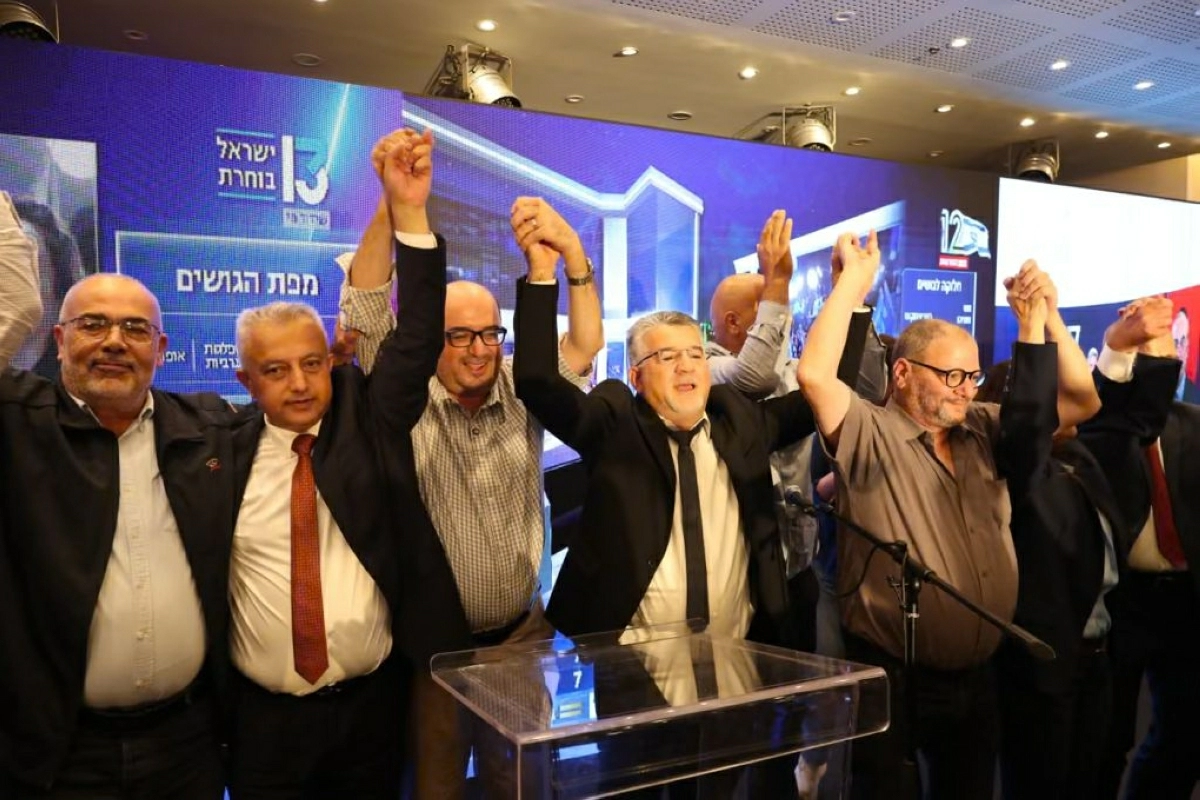

TEL AVIV — Israeli Prime Minister Benjamin Netanyahu edged ahead of opposition leader Gadi Eisenkot in the country’s tightly fought election, though a surge in the Arab vote ensured neither has a clear path toward forming a government.Netanyahu’s right-wing religious alliance was projected to win 53 seats in the 120-member parliament as of Wednesday afternoon, compared with a below-expected 48 for Eisenkot’s bloc. That was after almost 93% of votes had been counted.Israeli news site Ynet says that is essentially after all of the votes cast at polling stations, as the remainder come from absentee ballots.The two Israeli Arab parties almost doubled their projected number of seats to 19, making them the potential kingmakers during negotiations to secure a majority. Palestinian Israelis make up about 20% of the population.Sixty-one seats are needed for a majority in the Israeli Knesset, but there are doubts over whether the Jewish opposition will enter a deal with Palestinian parties to form a coalition government.Analysts have been pointing out what Democrats leader Yair Golan was emphasizing earlier: Netanyahu has lost and the Jewish and Palestinian Israeli parties opposing him have won the most support.Golan, who is a junior partner in the Change bloc, has been pushing for Jewish and Palestinian Israeli co-operation to form a government.In his first public statement since polls closed, Israeli President Isaac Herzog called for political parties to have “an open mind” in order to avoid another round of elections.“One thing must be clear, and I said this before the elections too: we must do everything we can, certainly after yesterday, to avoid another round of elections,” Herzog said on Wednesday afternoon, as the vote count neared its conclusion.However, Jewish Israeli and Palestinian Israeli parties teaming up to form a coalition is seen as a taboo – particularly after Netanyahu ramped up a racist, anti-Arab scare campaign in the wake of the October 7 attacks.But a political deal is not unprecedented.In 2021, the United Arab List (Ra’am) leader Mansour Abbas took his party into a historic coalition government with then right-wing leader Naftali Bennett, now part of the opposition bloc.Netanyahu had also started coalition negotiations with Abbas in previous years, although this election he’s described the idea as treasonous.Among the Jewish opposition in the Change bloc, unofficial leader Eisenkot has said that he would be open to a partnership if the Palestinian Israeli parties recognised Israel as a Jewish state.However, more right-wing parties in the bloc have refused to work alongside the Palestinians altogether.Palestinian Israeli politicians have asserted that they would make a deal with a minority government of Jewish Israeli parties, in order to remove Netanyahu from government.The Joint List, an alliance of Palestinian-Israeli parties, has performed particularly well, securing at least 11 seats in parliament.The general secretary of Hadash, the leading party in the Joint List coalition, said that although the Jewish opposition bloc had ruled out working with Palestinian parties, he thought their approach might change after the elections.“He cannot sit down [in coalition] with Netanyahu, and he won’t want to go back to another round of elections, so we think he can be flexible,” said Amjad Shbita.Joint List chairman Yousef Jabareen called for a genuine Jewish-Arab partnership to replace what he said was Netanyahu’s “government of bloodshed.” He also noted that anyone seeking to form an alternative would need to engage with Joint List.Ahmad Tibi, an Arab member of the Knesset and head of the Joint List parliamentary bloc, said the bloc was extending its hand to the “Change” to oust the government of Netanyahu.The “massive turnout among Arab citizens is a historic achievement for the Joint List, which answered the public’s call for unity and proved that it is a decisive force without which change is impossible,” Tibi said in a written statement.”We extend our hands toward the Change bloc to oust the Netanyahu-Ben-Gvir government — which will begin with the removal of Knesset Speaker Amir Ohana,” he added.TEL AVIV — Israeli Prime Minister Benjamin Netanyahu edged ahead of opposition leader Gadi Eisenkot in the country’s tightly fought election, though a surge in the Arab vote ensured neither has a clear path toward forming a government.Netanyahu’s right-wing religious alliance was projected to win 53 seats in the 120-member parliament as of Wednesday afternoon, compared with a below-expected 48 for Eisenkot’s bloc. That was after almost 93% of votes had been counted.Israeli news site Ynet says that is essentially after all of the votes cast at polling stations, as the remainder come from absentee ballots.The two Israeli Arab parties almost doubled their projected number of seats to 19, making them the potential kingmakers during negotiations to secure a majority. Palestinian Israelis make up about 20% of the population.Sixty-one seats are needed for a majority in the Israeli Knesset, but there are doubts over whether the Jewish opposition will enter a deal with Palestinian parties to form a coalition government.Analysts have been pointing out what Democrats leader Yair Golan was emphasizing earlier: Netanyahu has lost and the Jewish and Palestinian Israeli parties opposing him have won the most support.Golan, who is a junior partner in the Change bloc, has been pushing for Jewish and Palestinian Israeli co-operation to form a government.In his first public statement since polls closed, Israeli President Isaac Herzog called for political parties to have “an open mind” in order to avoid another round of elections.“One thing must be clear, and I said this before the elections too: we must do everything we can, certainly after yesterday, to avoid another round of elections,” Herzog said on Wednesday afternoon, as the vote count neared its conclusion.However, Jewish Israeli and Palestinian Israeli parties teaming up to form a coalition is seen as a taboo – particularly after Netanyahu ramped up a racist, anti-Arab scare campaign in the wake of the October 7 attacks.But a political deal is not unprecedented.In 2021, the United Arab List (Ra’am) leader Mansour Abbas took his party into a historic coalition government with then right-wing leader Naftali Bennett, now part of the opposition bloc.Netanyahu had also started coalition negotiations with Abbas in previous years, although this election he’s described the idea as treasonous.Among the Jewish opposition in the Change bloc, unofficial leader Eisenkot has said that he would be open to a partnership if the Palestinian Israeli parties recognised Israel as a Jewish state.However, more right-wing parties in the bloc have refused to work alongside the Palestinians altogether.Palestinian Israeli politicians have asserted that they would make a deal with a minority government of Jewish Israeli parties, in order to remove Netanyahu from government.The Joint List, an alliance of Palestinian-Israeli parties, has performed particularly well, securing at least 11 seats in parliament.The general secretary of Hadash, the leading party in the Joint List coalition, said that although the Jewish opposition bloc had ruled out working with Palestinian parties, he thought their approach might change after the elections.“He cannot sit down [in coalition] with Netanyahu, and he won’t want to go back to another round of elections, so we think he can be flexible,” said Amjad Shbita.Joint List chairman Yousef Jabareen called for a genuine Jewish-Arab partnership to replace what he said was Netanyahu’s “government of bloodshed.” He also noted that anyone seeking to form an alternative would need to engage with Joint List.Ahmad Tibi, an Arab member of the Knesset and head of the Joint List parliamentary bloc, said the bloc was extending its hand to the “Change” to oust the government of Netanyahu.The “massive turnout among Arab citizens is a historic achievement for the Joint List, which answered the public’s call for unity and proved that it is a decisive force without which change is impossible,” Tibi said in a written statement.”We extend our hands toward the Change bloc to oust the Netanyahu-Ben-Gvir government — which will begin with the removal of Knesset Speaker Amir Ohana,” he added.
Netanyahu edges ahead of Eisenkot but no majority to form government