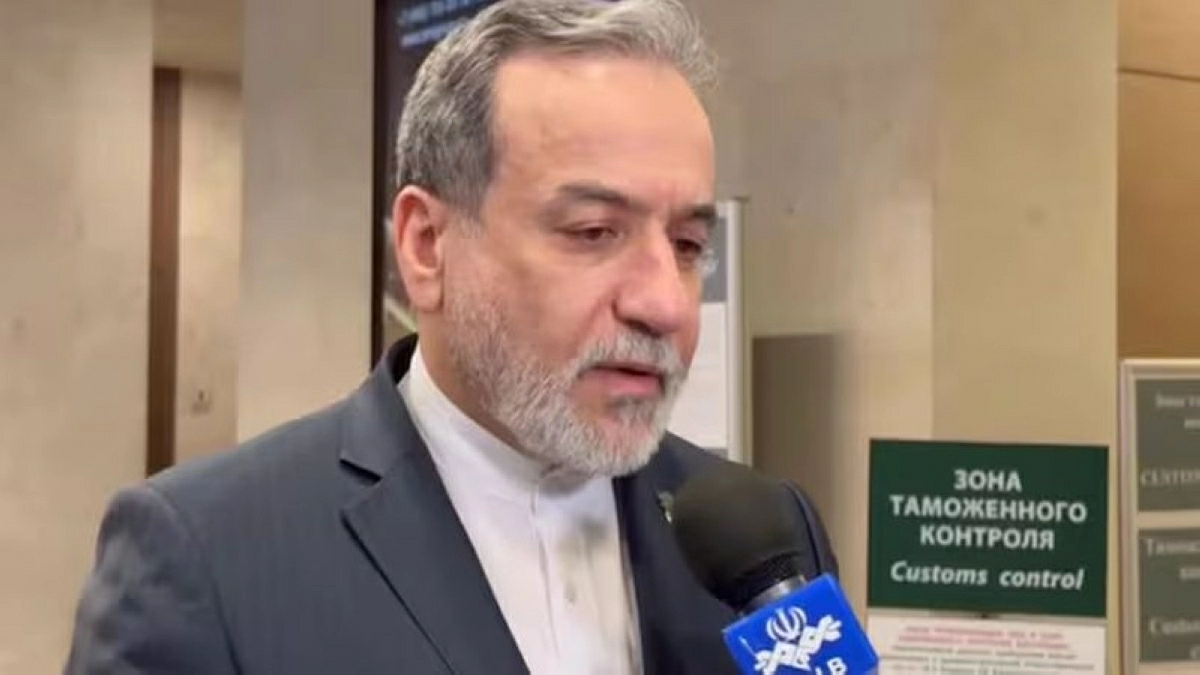

NEW DELHI — Iran’s foreign minister Abbas Araghchi on Thursday urged BRICS nations to condemn what he called violations of international law by the United States and Israel, including “their illegal aggression” his country. His remarks at a two-day meeting in New Delhi underscore divisions within the expanded BRICS bloc, as the US-Israeli war in Iran casts a shadow over the gathering of foreign ministers. Araghchi criticized Washington, describing the war as “illegal expansionism and warmongering,” and said Iran remained open to diplomacy while being ready to defend itself “with all available means.” “Iran therefore calls upon BRICS member states and all responsible members of the international community to explicitly condemn violations of international law by the United States and Israel,” he said. The conflict, which began on February 28, has heightened geopolitical tensions and sparked a global energy crisis. In his opening remarks, Indian Foreign Minister S. Jaishankar struck a cautious tone, avoiding direct criticism while stressing the importance of stability. “The conflict in West Asia merits particular attention,” Jaishankar said, without naming specific countries. He said unimpeded maritime flows through international waterways, including the Strait of Hormuz and the Red Sea, were vital for global economic well-being. He also flagged concerns over the growing use of unilateral sanctions, a longstanding point of contention among BRICS members. “There is an increasing resort to unilateral coercive measures and sanctions inconsistent with international law and the UN Charter,” he said. “Such measures disproportionately affect developing countries. These unjustifiable measures cannot substitute dialogue, nor can pressure replace diplomacy.” Jaishankar added that emerging economies expect BRICS to play a “constructive and stabilizing role” at a time of rising geopolitical fragmentation and economic uncertainty. The grouping, originally comprising Brazil, Russia, India and China, was expanded to include South Africa in 2011, and more recently admitted Egypt, Ethiopia, Indonesia, Iran and the United Arab Emirates (UAE). The expansion has boosted its global weight but also increased internal divergences on geopolitical issues. India holds the BRICS chair for 2026. Iran’s stance could make it difficult for BRICS — which operates by consensus — to agree on a joint statement, given the UAE’s presence on the opposing side. Iran has launched numerous attacks on the UAE and other neighboring countries. The effective closure of the Strait of Hormuz — a critical artery that handles roughly a fifth of global oil shipments — has triggered one of the biggest supply disruptions in recent history. The curbs on tanker traffic have pushed crude prices sharply higher, fuelling fears of renewed inflation, tighter financial conditions and a potential global economic slowdown, particularly for energy-importing economies such as India. Separately, India’s foreign ministry said on Thursday that an Indian-flagged ship was attacked off the coast of Oman on Wednesday and all crew on board were safe. “The attack … is unacceptable and we deplore the fact that commercial shipping and civilian mariners continue to be targeted.” However, two LPG tankers announcing India as their destination have crossed the Strait of Hormuz between Wednesday and Thursday, ship tracking data indicates. The Marshall Islands-flagged Symi and Vietnam-flagged NV Sunshine are the first India-bound energy tankers to transit the fraught waters of the Strait of Hormuz in nearly two weeks. Both the LPG tankers have stated Gujarat’s Kandla port as their intended destination. So far, 10 India-flagged vessels—nine LPG tankers and one crude oil tanker—have crossed the Strait of Hormuz since early March.NEW DELHI — Iran’s foreign minister Abbas Araghchi on Thursday urged BRICS nations to condemn what he called violations of international law by the United States and Israel, including “their illegal aggression” his country. His remarks at a two-day meeting in New Delhi underscore divisions within the expanded BRICS bloc, as the US-Israeli war in Iran casts a shadow over the gathering of foreign ministers. Araghchi criticized Washington, describing the war as “illegal expansionism and warmongering,” and said Iran remained open to diplomacy while being ready to defend itself “with all available means.” “Iran therefore calls upon BRICS member states and all responsible members of the international community to explicitly condemn violations of international law by the United States and Israel,” he said. The conflict, which began on February 28, has heightened geopolitical tensions and sparked a global energy crisis. In his opening remarks, Indian Foreign Minister S. Jaishankar struck a cautious tone, avoiding direct criticism while stressing the importance of stability. “The conflict in West Asia merits particular attention,” Jaishankar said, without naming specific countries. He said unimpeded maritime flows through international waterways, including the Strait of Hormuz and the Red Sea, were vital for global economic well-being. He also flagged concerns over the growing use of unilateral sanctions, a longstanding point of contention among BRICS members. “There is an increasing resort to unilateral coercive measures and sanctions inconsistent with international law and the UN Charter,” he said. “Such measures disproportionately affect developing countries. These unjustifiable measures cannot substitute dialogue, nor can pressure replace diplomacy.” Jaishankar added that emerging economies expect BRICS to play a “constructive and stabilizing role” at a time of rising geopolitical fragmentation and economic uncertainty. The grouping, originally comprising Brazil, Russia, India and China, was expanded to include South Africa in 2011, and more recently admitted Egypt, Ethiopia, Indonesia, Iran and the United Arab Emirates (UAE). The expansion has boosted its global weight but also increased internal divergences on geopolitical issues. India holds the BRICS chair for 2026. Iran’s stance could make it difficult for BRICS — which operates by consensus — to agree on a joint statement, given the UAE’s presence on the opposing side. Iran has launched numerous attacks on the UAE and other neighboring countries. The effective closure of the Strait of Hormuz — a critical artery that handles roughly a fifth of global oil shipments — has triggered one of the biggest supply disruptions in recent history. The curbs on tanker traffic have pushed crude prices sharply higher, fuelling fears of renewed inflation, tighter financial conditions and a potential global economic slowdown, particularly for energy-importing economies such as India. Separately, India’s foreign ministry said on Thursday that an Indian-flagged ship was attacked off the coast of Oman on Wednesday and all crew on board were safe. “The attack … is unacceptable and we deplore the fact that commercial shipping and civilian mariners continue to be targeted.” However, two LPG tankers announcing India as their destination have crossed the Strait of Hormuz between Wednesday and Thursday, ship tracking data indicates. The Marshall Islands-flagged Symi and Vietnam-flagged NV Sunshine are the first India-bound energy tankers to transit the fraught waters of the Strait of Hormuz in nearly two weeks. Both the LPG tankers have stated Gujarat’s Kandla port as their intended destination. So far, 10 India-flagged vessels—nine LPG tankers and one crude oil tanker—have crossed the Strait of Hormuz since early March.
Araghchi urges BRICS to condemn US and Israel for war on Iran