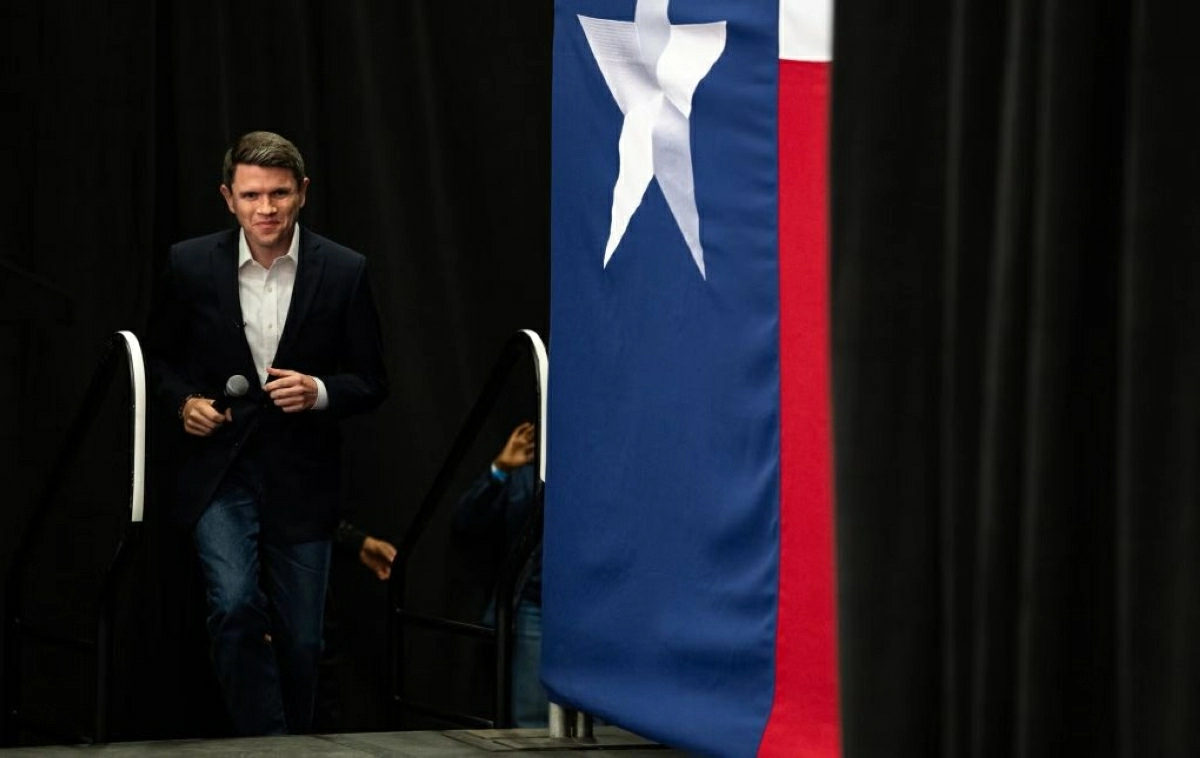

WASHINGTON — Democrats are showing considerable strength in the final days ahead of the Nov. 3 US midterm elections, with new polls showing that the party is leading in five Republican-held Senate battleground states and maintaining a narrow advantage in another, potentially putting control of the upper chamber within reach.According to the latest polls from The New York Times and Siena University before the midterm elections, Democratic candidates are ahead in Texas, Kansas, Maine and Ohio, as well as Alaska, while the contest in Iowa remains virtually tied.Democrats are also leading in Michigan, a state where the party currently holds the Senate seat.The findings come as Democrats seek to regain control of Congress amid voter dissatisfaction with President Donald Trump and growing concerns over the state of the economy and the cost of living.The New York Times/Siena surveys found that Democrats hold sizable leads in Texas, which has not elected a Democrat to the Senate since 1988, and Kansas, which has not elected one since 1932.To win a Senate majority, Democrats need to defend all the seats they currently hold and flip at least four seats that are currently held by Republicans. It has been seen as an uphill battle because many of the seats they need to win are in Republican strongholds.The surveys did not include North Carolina, where polls have long found the Democrat leading and Republicans have pared back their campaign spending.Dissatisfaction with President Donald Trump and frustration over his management of the economy are dragging down Republicans, according to the polls. Just 38 percent of likely voters approved of the president’s job performance in the seven states in the poll, a strikingly low figure given that Trump had won five of the states by double digits just two years ago.The newfound Democratic strength was powered by growing trust in the party to handle the economy — the key motivating issue for voters this year. Democrats hold a nine-point advantage on the cost of living across the battlegrounds, and they led on this crucial measure in every single state.If the polls are accurate and these trends hold, Democrats would win control of the Senate.But there were some reasons for Democratic concern: There are still some undecided voters, and voters who decided only in the last month favored Republicans by a nine-point margin.In the Senate race in Texas, James Talarico, a Democratic state legislator, held a seven-point edge over Ken Paxton, the Republican state attorney general, 50 percent to 43 percent among likely voters. Paxton had the worst image of any candidate included in the survey — by far.In Maine, Senator Susan Collins, the last remaining Republican senator in New England, is trailing in her re-election campaign behind Troy Jackson, a Democratic former state senator. Jackson leads 51 percent to 45 percent among likely voters.Polls are imperfect. Six years ago, Ms. Collins had trailed in every survey before the election — and she still won re-election comfortably.But the new polls revealed a series of flashing warning signs for Republicans — about both their candidates and the broader political environment.In every state but Maine, the Democratic Senate candidate was viewed more favorably than the Republican candidate.And likely voters were unhappy with the leadership of Trump across the board, and said that they believed Democrats would do a better job handling the cost of living and foreign wars and doing what is best for ordinary people.Trump has been barnstorming Republican states in a bid to re-energize his base in the final weeks before Election Day, but the polls suggest that enthusiasm for the president is slipping even within his party. In Ohio, where 82 percent of Republicans approve of the president, the share who approve “strongly” has fallen to 51 percent, down from 63 percent in June.And in a Times/Siena poll last week, the Senate race was tied in heavily Republican South Carolina.One key advantage for Democratic candidates is that they are leading with independent voters in every state surveyed. That includes Iowa, where Josh Turek, a Democratic state legislator, was effectively tied with Representative Ashley Hinson, the Republican nominee.The polls found that the Democratic resurgence was powered by a renewed strength among younger voters and Latinos, as well as the relative weakness Republicans have among the party’s base of white, working-class voters.Trump had made gains among Latino and younger voters in 2024. But this year, his party’s Senate candidates were winning only about one-quarter of younger voters and Latino voters.Crumbling trust in Republicans on the economy — and in Trump in particular — helps to explain how Democrats are competitive in a state like Kansas. Trump won Kansas by the widest margin of any of the seven states polled, and the state has not elected a Democratic senator for nearly a century. But diesel prices that rose after the Iran war, and the administration’s decision to drop import tariffs on foreign beef, have dismayed farmers.Adam Hamilton, the Democratic nominee and the pastor of the largest church in the state, leads Senator Roger Marshall, the Republican incumbent, 49 percent to 44 percent. Hamilton also the support of 13 percent of Republicans, including James Gerety, 52, a retired National Guardsman living in Meriden, Kan., who said that he saw Hamilton as “a lot more genuine” than Marshall.“I had reservations at first, with him being a pastor,” said Gerety, a registered Republican who considers himself more of an independent. “I get squirrelly with religion being brought into politics. But Hamilton is trying to lower prices, to get us out of this war with Iran. He’s trying to bring inflation down.” Marshall has also faced criticism after The New York Times reported that he sued patients for unpaid medical debt, leading to arrests in some cases.The Times previously polled all seven states in September. The Democrats improved in six of the states in the final poll (Iowa, Kansas, Maine, Michigan, Ohio and Texas) and lost ground in only one (Alaska).White working-class voters have been the backbone of Trump’s coalition. In 2024, he won an estimated 66 percent of white voters without college degrees, according to exit polls and Times Voter Trends. Now, in these seven states, Republicans were winning just 56 percent of these voters.Blue-collar white voters have proved particularly hard to reach in polls, and polling error has previously been among the highest in that demographic, a large group in all seven states.In Michigan, the lone Senate seat in the survey currently held by a Democrat, the poll showed Dr. Abdul El-Sayed ahead by a wide 11 percentage points over Mike Rogers, a Republican former congressman, who narrowly lost a Senate run in 2024.Dr. El-Sayed, who has relished political combat in a way few other Democrats do, has performed especially well with men, a group that historically tilts Republican. He is running roughly even with the group, an improvement from September.But in the Democratic primary, polls overestimated Dr. El-Sayed’s strength. And he has been embroiled in a bitter public feud with his primary rival, Representative Haley Stevens, who endorsed Rogers on Sunday in a rare cross-partisan embrace that has given Republicans hope. Still, Dr. El-Sayed is ahead by a wide margin on every issue in the poll, including immigration, a traditional Republican strength.In Ohio, former Senator Sherrod Brown, a Democrat, leads Senator Jon Husted, a Republican, 49 percent to 44 percent in a race that has drawn half a billion dollars in spending, with Republicans spending $80 million more on ads, according to AdImpact, the ad-tracking service.In Maine, Jackson, the Democratic challenger, has improved his image since September, though he is still seen unfavorably overall. Critically, he is running in the most Democratic state on the battleground map, and he remains much more popular than Trump.In Texas, 49 percent of likely voters view Talarico favorably, while 39 percent view him unfavorably, giving him a 10-point edge on favorability despite an enormous, very negative ad campaign against him funded chiefly by Elon Musk, the world’s richest person. Paxton, Talarico’s G.O.P. opponent, has seen his image decline in recent months. Fifty-four percent of likely voters there now view him unfavorably, while only 33 percent view him favorably.Rey Gonzales, a 62-year-old Republican living in Houston, said that he had been troubled by the allegations that led to Paxton’s impeachment and by reports that he had been unfaithful in his marriage. Gonzales, who says he voted for Trump in 2016 and 2020 but did not vote in 2024, says he plans to support Talarico purely out of dislike for Paxton.When asked what he liked about Talarico, his answer was succinct: “Nothing.”In Alaska, Mary Peltola, the former Democratic congresswoman challenging Senator Dan Sullivan, has faced criticism after a New York Times investigation found political operatives aligned with her recruited another candidate, Dan J. Sullivan, to run as a Republican in the race to try to pull votes away from the Republican incumbent.The poll was mostly completed before the release of the story. Even so, Ms. Peltola was the only Democrat in this set of polls to lose ground since an earlier Times/Siena poll. The poll found her with a narrow edge over Sullivan, 48 percent to 46 percent.WASHINGTON — Democrats are showing considerable strength in the final days ahead of the Nov. 3 US midterm elections, with new polls showing that the party is leading in five Republican-held Senate battleground states and maintaining a narrow advantage in another, potentially putting control of the upper chamber within reach.According to the latest polls from The New York Times and Siena University before the midterm elections, Democratic candidates are ahead in Texas, Kansas, Maine and Ohio, as well as Alaska, while the contest in Iowa remains virtually tied.Democrats are also leading in Michigan, a state where the party currently holds the Senate seat.The findings come as Democrats seek to regain control of Congress amid voter dissatisfaction with President Donald Trump and growing concerns over the state of the economy and the cost of living.The New York Times/Siena surveys found that Democrats hold sizable leads in Texas, which has not elected a Democrat to the Senate since 1988, and Kansas, which has not elected one since 1932.To win a Senate majority, Democrats need to defend all the seats they currently hold and flip at least four seats that are currently held by Republicans. It has been seen as an uphill battle because many of the seats they need to win are in Republican strongholds.The surveys did not include North Carolina, where polls have long found the Democrat leading and Republicans have pared back their campaign spending.Dissatisfaction with President Donald Trump and frustration over his management of the economy are dragging down Republicans, according to the polls. Just 38 percent of likely voters approved of the president’s job performance in the seven states in the poll, a strikingly low figure given that Trump had won five of the states by double digits just two years ago.The newfound Democratic strength was powered by growing trust in the party to handle the economy — the key motivating issue for voters this year. Democrats hold a nine-point advantage on the cost of living across the battlegrounds, and they led on this crucial measure in every single state.If the polls are accurate and these trends hold, Democrats would win control of the Senate.But there were some reasons for Democratic concern: There are still some undecided voters, and voters who decided only in the last month favored Republicans by a nine-point margin.In the Senate race in Texas, James Talarico, a Democratic state legislator, held a seven-point edge over Ken Paxton, the Republican state attorney general, 50 percent to 43 percent among likely voters. Paxton had the worst image of any candidate included in the survey — by far.In Maine, Senator Susan Collins, the last remaining Republican senator in New England, is trailing in her re-election campaign behind Troy Jackson, a Democratic former state senator. Jackson leads 51 percent to 45 percent among likely voters.Polls are imperfect. Six years ago, Ms. Collins had trailed in every survey before the election — and she still won re-election comfortably.But the new polls revealed a series of flashing warning signs for Republicans — about both their candidates and the broader political environment.In every state but Maine, the Democratic Senate candidate was viewed more favorably than the Republican candidate.And likely voters were unhappy with the leadership of Trump across the board, and said that they believed Democrats would do a better job handling the cost of living and foreign wars and doing what is best for ordinary people.Trump has been barnstorming Republican states in a bid to re-energize his base in the final weeks before Election Day, but the polls suggest that enthusiasm for the president is slipping even within his party. In Ohio, where 82 percent of Republicans approve of the president, the share who approve “strongly” has fallen to 51 percent, down from 63 percent in June.And in a Times/Siena poll last week, the Senate race was tied in heavily Republican South Carolina.One key advantage for Democratic candidates is that they are leading with independent voters in every state surveyed. That includes Iowa, where Josh Turek, a Democratic state legislator, was effectively tied with Representative Ashley Hinson, the Republican nominee.The polls found that the Democratic resurgence was powered by a renewed strength among younger voters and Latinos, as well as the relative weakness Republicans have among the party’s base of white, working-class voters.Trump had made gains among Latino and younger voters in 2024. But this year, his party’s Senate candidates were winning only about one-quarter of younger voters and Latino voters.Crumbling trust in Republicans on the economy — and in Trump in particular — helps to explain how Democrats are competitive in a state like Kansas. Trump won Kansas by the widest margin of any of the seven states polled, and the state has not elected a Democratic senator for nearly a century. But diesel prices that rose after the Iran war, and the administration’s decision to drop import tariffs on foreign beef, have dismayed farmers.Adam Hamilton, the Democratic nominee and the pastor of the largest church in the state, leads Senator Roger Marshall, the Republican incumbent, 49 percent to 44 percent. Hamilton also the support of 13 percent of Republicans, including James Gerety, 52, a retired National Guardsman living in Meriden, Kan., who said that he saw Hamilton as “a lot more genuine” than Marshall.“I had reservations at first, with him being a pastor,” said Gerety, a registered Republican who considers himself more of an independent. “I get squirrelly with religion being brought into politics. But Hamilton is trying to lower prices, to get us out of this war with Iran. He’s trying to bring inflation down.” Marshall has also faced criticism after The New York Times reported that he sued patients for unpaid medical debt, leading to arrests in some cases.The Times previously polled all seven states in September. The Democrats improved in six of the states in the final poll (Iowa, Kansas, Maine, Michigan, Ohio and Texas) and lost ground in only one (Alaska).White working-class voters have been the backbone of Trump’s coalition. In 2024, he won an estimated 66 percent of white voters without college degrees, according to exit polls and Times Voter Trends. Now, in these seven states, Republicans were winning just 56 percent of these voters.Blue-collar white voters have proved particularly hard to reach in polls, and polling error has previously been among the highest in that demographic, a large group in all seven states.In Michigan, the lone Senate seat in the survey currently held by a Democrat, the poll showed Dr. Abdul El-Sayed ahead by a wide 11 percentage points over Mike Rogers, a Republican former congressman, who narrowly lost a Senate run in 2024.Dr. El-Sayed, who has relished political combat in a way few other Democrats do, has performed especially well with men, a group that historically tilts Republican. He is running roughly even with the group, an improvement from September.But in the Democratic primary, polls overestimated Dr. El-Sayed’s strength. And he has been embroiled in a bitter public feud with his primary rival, Representative Haley Stevens, who endorsed Rogers on Sunday in a rare cross-partisan embrace that has given Republicans hope. Still, Dr. El-Sayed is ahead by a wide margin on every issue in the poll, including immigration, a traditional Republican strength.In Ohio, former Senator Sherrod Brown, a Democrat, leads Senator Jon Husted, a Republican, 49 percent to 44 percent in a race that has drawn half a billion dollars in spending, with Republicans spending $80 million more on ads, according to AdImpact, the ad-tracking service.In Maine, Jackson, the Democratic challenger, has improved his image since September, though he is still seen unfavorably overall. Critically, he is running in the most Democratic state on the battleground map, and he remains much more popular than Trump.In Texas, 49 percent of likely voters view Talarico favorably, while 39 percent view him unfavorably, giving him a 10-point edge on favorability despite an enormous, very negative ad campaign against him funded chiefly by Elon Musk, the world’s richest person. Paxton, Talarico’s G.O.P. opponent, has seen his image decline in recent months. Fifty-four percent of likely voters there now view him unfavorably, while only 33 percent view him favorably.Rey Gonzales, a 62-year-old Republican living in Houston, said that he had been troubled by the allegations that led to Paxton’s impeachment and by reports that he had been unfaithful in his marriage. Gonzales, who says he voted for Trump in 2016 and 2020 but did not vote in 2024, says he plans to support Talarico purely out of dislike for Paxton.When asked what he liked about Talarico, his answer was succinct: “Nothing.”In Alaska, Mary Peltola, the former Democratic congresswoman challenging Senator Dan Sullivan, has faced criticism after a New York Times investigation found political operatives aligned with her recruited another candidate, Dan J. Sullivan, to run as a Republican in the race to try to pull votes away from the Republican incumbent.The poll was mostly completed before the release of the story. Even so, Ms. Peltola was the only Democrat in this set of polls to lose ground since an earlier Times/Siena poll. The poll found her with a narrow edge over Sullivan, 48 percent to 46 percent.
Democrats gain ground in key Senate battlegrounds, new polls show