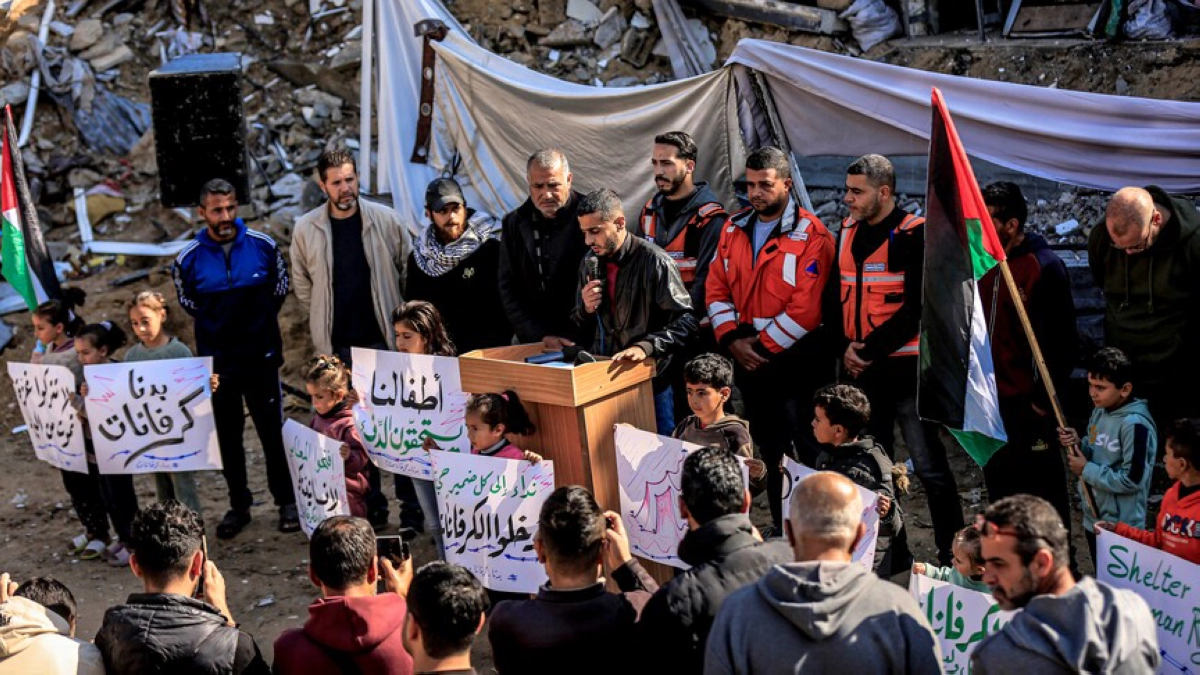

GAZA — Dozens of displaced Palestinians staged a protest Sunday in central Gaza against Israel’s ongoing blockade and worsening humanitarian conditions in the enclave, calling for crossings to be reopened and humanitarian aid to enter without restrictions.Participants raised Palestinian flags and banners condemning deteriorating living conditions and food shortages, calling for unrestricted access to food and medicine, the Anadolu news agency reported.Ali Al-Shashniya, coordinator and spokesman for tribal and popular committees in the Al-Bureij refugee camp, told Anadolu that Gaza residents were facing increasingly difficult humanitarian conditions amid the continued blockade and food shortages.He said thousands of families and displaced people rely primarily on humanitarian aid to meet their daily needs, warning that the humanitarian situation could worsen if restrictions on aid deliveries continue.Hassan Rayyan, a displaced Palestinian from northern Gaza, said thousands of families had lost their homes and sources of income during the Israel-Hamas war and now depend on humanitarian assistance for basic needs.“We want to live with dignity. We lost our homes and our humanitarian situation has become extremely difficult,” he told Anadolu.Some protesters carried empty cooking pots as a symbol of the worsening food crisis facing Palestinian families in the enclave.The protests came amid continued restrictions on aid access and delays in implementing key ceasefire commitments, including reopening Gaza crossings.According to the World Food Program, 1.6 million people in Gaza, representing 77% of the population, face severe levels of acute food insecurity, including more than 100,000 children and 37,000 pregnant and breastfeeding women.More than 880 people have been killed and over 2,645 injured in Israeli attacks since the ceasefire between Israel and the Palestinian group Hamas was announced on Oct. 10, 2025, according to Gaza’s Health Ministry.The agreement was meant to halt Israel’s two-year war, which killed more than 72,000 people, most of them women and children, and injured over 172,000 since October 2023 and caused massive destruction affecting 90% of civilian infrastructure.According to the UN Office for the Coordination of Humanitarian Affairs (OCHA) , Gaza remains trapped in a worsening humanitarian crisis marked by collapsing healthcare services, mass displacement, and severe shortages of essential supplies seven months after the ceasefire brokered by US President Donald Trump.Although large-scale violence has declined, shortages of medical supplies, widespread displacement, and collapsing infrastructure continue to threaten the lives of civilians across the Strip, the UN agency said in a report on May 15.Reports of attacks striking residential areas also continue, while most residents are sheltering in overcrowded tents or damaged buildings.WHO Representative in the Occupied Palestinian Territory Renee Van de Weerdt recently returned from Gaza and delivered a briefing at the UN in Geneva on Friday.“Nothing prepares you for Gaza,” she said, describing the scale of devastation witnessed across the strip.According to WHO figures cited during the briefing, at least 880 Palestinians have been killed and more than 2,600 injured since October 2025.Gaza’s healthcare system remains on the brink of collapse. Barely half of the territory’s hospitals are partially functional, while none are operating at full capacity.Attacks on healthcare facilities continue, alongside severe shortages of medicines, laboratory equipment, oxygen concentrators, reagents, and orthopaedic supplies, WHO added.Van de Weerdt stressed that many of the blocked items are not “dual-use” materials but essential medical supplies included on WHO’s international lists.GAZA — Dozens of displaced Palestinians staged a protest Sunday in central Gaza against Israel’s ongoing blockade and worsening humanitarian conditions in the enclave, calling for crossings to be reopened and humanitarian aid to enter without restrictions.Participants raised Palestinian flags and banners condemning deteriorating living conditions and food shortages, calling for unrestricted access to food and medicine, the Anadolu news agency reported.Ali Al-Shashniya, coordinator and spokesman for tribal and popular committees in the Al-Bureij refugee camp, told Anadolu that Gaza residents were facing increasingly difficult humanitarian conditions amid the continued blockade and food shortages.He said thousands of families and displaced people rely primarily on humanitarian aid to meet their daily needs, warning that the humanitarian situation could worsen if restrictions on aid deliveries continue.Hassan Rayyan, a displaced Palestinian from northern Gaza, said thousands of families had lost their homes and sources of income during the Israel-Hamas war and now depend on humanitarian assistance for basic needs.“We want to live with dignity. We lost our homes and our humanitarian situation has become extremely difficult,” he told Anadolu.Some protesters carried empty cooking pots as a symbol of the worsening food crisis facing Palestinian families in the enclave.The protests came amid continued restrictions on aid access and delays in implementing key ceasefire commitments, including reopening Gaza crossings.According to the World Food Program, 1.6 million people in Gaza, representing 77% of the population, face severe levels of acute food insecurity, including more than 100,000 children and 37,000 pregnant and breastfeeding women.More than 880 people have been killed and over 2,645 injured in Israeli attacks since the ceasefire between Israel and the Palestinian group Hamas was announced on Oct. 10, 2025, according to Gaza’s Health Ministry.The agreement was meant to halt Israel’s two-year war, which killed more than 72,000 people, most of them women and children, and injured over 172,000 since October 2023 and caused massive destruction affecting 90% of civilian infrastructure.According to the UN Office for the Coordination of Humanitarian Affairs (OCHA) , Gaza remains trapped in a worsening humanitarian crisis marked by collapsing healthcare services, mass displacement, and severe shortages of essential supplies seven months after the ceasefire brokered by US President Donald Trump.Although large-scale violence has declined, shortages of medical supplies, widespread displacement, and collapsing infrastructure continue to threaten the lives of civilians across the Strip, the UN agency said in a report on May 15.Reports of attacks striking residential areas also continue, while most residents are sheltering in overcrowded tents or damaged buildings.WHO Representative in the Occupied Palestinian Territory Renee Van de Weerdt recently returned from Gaza and delivered a briefing at the UN in Geneva on Friday.“Nothing prepares you for Gaza,” she said, describing the scale of devastation witnessed across the strip.According to WHO figures cited during the briefing, at least 880 Palestinians have been killed and more than 2,600 injured since October 2025.Gaza’s healthcare system remains on the brink of collapse. Barely half of the territory’s hospitals are partially functional, while none are operating at full capacity.Attacks on healthcare facilities continue, alongside severe shortages of medicines, laboratory equipment, oxygen concentrators, reagents, and orthopaedic supplies, WHO added.Van de Weerdt stressed that many of the blocked items are not “dual-use” materials but essential medical supplies included on WHO’s international lists.
Displaced Palestinians protest against ongoing Israeli blockade on Gaza