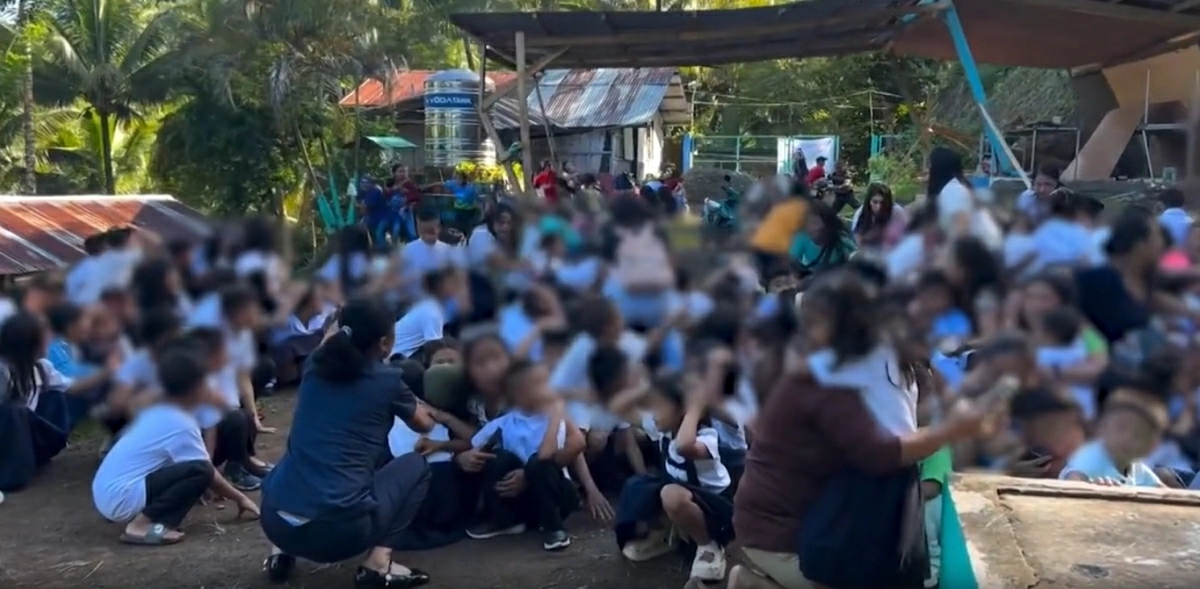

MANILA — A powerful earthquake in the Philippines has killed more than 40 people, injured hundreds and left thousands displaced, with rescue efforts hampered by aftershocks and damaged infrastructure.Doctors treated patients in tents set up under a scorching Philippine sun on Tuesday — including helping a young mother give birth.Thousands remained displaced following the quake that struck off the southern island of Mindanao on Monday, according to national and local disaster agencies.As of Tuesday morning, the death toll compiled from provincial sources stood at 41, which officials fear could rise, while the number of injured was 487 though only four people were now believed to be missing.In hardest-hit Sarangani province, some areas remain accessible only by helicopter and fears of aftershocks were slowing rescue efforts, local officials told reporters at a Tuesday briefing.”There are still aftershocks, so the rescuers are very cautious in their approach. That’s a challenge,” said regional civil defence chief Rodrigo Sosmena.A series of powerful aftershocks rocked the area from about two hours after the first quake, while hundreds of tiny quakes followed.Infrastructure damage, meanwhile, means some communities will be cut off for at least a week because of the damage to roads and the collapse of a bridge.At a hospital just outside General Santos, the region’s largest city, AFP reporters heard cries of “push” then an infant’s cries as a mother gave birth outdoors behind a makeshift screen.In Glan municipality, where at least 13 people were buried in their homes by a landslide, staff at another hospital said more than 60 patients were on beds outside the facility due to fears for the building’s structural integrity.”The hospital sustained a lot of damage,” she said. “The municipal engineer decided we could not use the building.”Outside a collapsed grocery store in General Santos, rescuers resumed efforts after an overnight break to recover two store employees who were inside when the building crumpled.AFP journalists watched as rescue dogs and their handlers scoured the pile of broken concrete and jagged metal bars.A local rescuer told reporters the effort was now one of recovery rather than rescue, though a more senior official later insisted that decision had yet to be formally made.At a nearby beach resort, a high-speed Coast Guard vessel plied the waters for two people who went missing while swimming in waters that churned violently as the quake struck.Videos posted to social media on Monday showed the catastrophic collapse of a shopping centre with a Jollibee fast food restaurant in General Santos, while an unoccupied school building crumpled in another.In another video, young schoolchildren could be seen screaming in the arms of their teachers as the quake violently swayed them back and forth on the ground.A flimsy metal structure could be seen toppling in the background as the video uploaded to the school’s official Facebook page ends. An accompanying caption said no one was under the structure when it fell.The scale of devastation on Mindanao island is becoming clear as emergency responders reach coastal cities and towns.Buildings have collapsed and roads are either cracked or buried in landslides. Large swathes of the island still have no electricity or telephone connectivity.”We hope the death toll does not increase further, but we are expecting it to move. Our priority today is search and rescue,” Bernardo Alejandro, assistant secretary of the agency supervising disaster response, told DZMM radio.Close to 2,000 homes and hundreds of public schools have been damaged by their estimate so far, he added.The Philippines is routinely struck by earthquakes and volcanic eruptions because it lies on the so-called Pacific Ring of Fire, where there is increased seismic activity.Monday’s quake was caused by a movement on the Cotabato Trench, off the country’s southern tip.The trench, which is a source of huge quakes, generated a magnitude 7.9 earthquake in 1976, triggering a tsunami that killed about 5,000 people.Monday’s quake sowed panic in otherwise sleepy parts of Mindanao. Mobile phone and CCTV cameras captured scenes of buildings crumbling to the ground and children screaming as the ground shook.Public school teacher Cesar Sundo, who lives in Lebak town, said the earthquake felt like he was “being vigorously rocked on a hammock for more than two minutes. … and the shaking was getting stronger by the second.””Everyone felt dizzy. Our students were shouting and crying while and we needed to calm them down. And it was thousands of students.”Sundo said the students, who were mostly 13-year-olds, stayed on school grounds until they were advised to go home.”We were literally saved by our flag ceremony,” he said, explaining that they were outside when the quake struckScience minister and veteran seismologist, Renato Solidum, said many students survived because they were attending the morning assembly, which happens every Monday.”They were lucky to be outside. They were able to stay put and sit down,” Solidum told DZMM in a separate interview.”These areas have experienced strong earthquakes before. This is one of the strongest.”One viral video showed a branch of beloved fast-food chain Jollibee in General Santos City collapsing as onlookers watched in horror.The chain issued a statement on Monday night saying all its staff in earthquake-hit areas are safe.President Ferdinand Marcos Jr said he had mobilised the entire government machinery to respond to the calamity.His transportation and health secretaries have flown to Mindanao from the capital Manila to oversee the response. Health secretary Teodoro Herbosa said aftershocks, some of them quite strong, hiteven as doctors treated the injured.Access to some towns, such as Jose Abad Santos in Davao Occidental on Mindanao’s east side, remains difficult.Mayor Jason John Joyce told DZMM that landslides have buried his town’s only highway, leaving half of it accessible by road.”Relief goods have to be flown in to far-flung barangays (villages),” he added.MANILA — A powerful earthquake in the Philippines has killed more than 40 people, injured hundreds and left thousands displaced, with rescue efforts hampered by aftershocks and damaged infrastructure.Doctors treated patients in tents set up under a scorching Philippine sun on Tuesday — including helping a young mother give birth.Thousands remained displaced following the quake that struck off the southern island of Mindanao on Monday, according to national and local disaster agencies.As of Tuesday morning, the death toll compiled from provincial sources stood at 41, which officials fear could rise, while the number of injured was 487 though only four people were now believed to be missing.In hardest-hit Sarangani province, some areas remain accessible only by helicopter and fears of aftershocks were slowing rescue efforts, local officials told reporters at a Tuesday briefing.”There are still aftershocks, so the rescuers are very cautious in their approach. That’s a challenge,” said regional civil defence chief Rodrigo Sosmena.A series of powerful aftershocks rocked the area from about two hours after the first quake, while hundreds of tiny quakes followed.Infrastructure damage, meanwhile, means some communities will be cut off for at least a week because of the damage to roads and the collapse of a bridge.At a hospital just outside General Santos, the region’s largest city, AFP reporters heard cries of “push” then an infant’s cries as a mother gave birth outdoors behind a makeshift screen.In Glan municipality, where at least 13 people were buried in their homes by a landslide, staff at another hospital said more than 60 patients were on beds outside the facility due to fears for the building’s structural integrity.”The hospital sustained a lot of damage,” she said. “The municipal engineer decided we could not use the building.”Outside a collapsed grocery store in General Santos, rescuers resumed efforts after an overnight break to recover two store employees who were inside when the building crumpled.AFP journalists watched as rescue dogs and their handlers scoured the pile of broken concrete and jagged metal bars.A local rescuer told reporters the effort was now one of recovery rather than rescue, though a more senior official later insisted that decision had yet to be formally made.At a nearby beach resort, a high-speed Coast Guard vessel plied the waters for two people who went missing while swimming in waters that churned violently as the quake struck.Videos posted to social media on Monday showed the catastrophic collapse of a shopping centre with a Jollibee fast food restaurant in General Santos, while an unoccupied school building crumpled in another.In another video, young schoolchildren could be seen screaming in the arms of their teachers as the quake violently swayed them back and forth on the ground.A flimsy metal structure could be seen toppling in the background as the video uploaded to the school’s official Facebook page ends. An accompanying caption said no one was under the structure when it fell.The scale of devastation on Mindanao island is becoming clear as emergency responders reach coastal cities and towns.Buildings have collapsed and roads are either cracked or buried in landslides. Large swathes of the island still have no electricity or telephone connectivity.”We hope the death toll does not increase further, but we are expecting it to move. Our priority today is search and rescue,” Bernardo Alejandro, assistant secretary of the agency supervising disaster response, told DZMM radio.Close to 2,000 homes and hundreds of public schools have been damaged by their estimate so far, he added.The Philippines is routinely struck by earthquakes and volcanic eruptions because it lies on the so-called Pacific Ring of Fire, where there is increased seismic activity.Monday’s quake was caused by a movement on the Cotabato Trench, off the country’s southern tip.The trench, which is a source of huge quakes, generated a magnitude 7.9 earthquake in 1976, triggering a tsunami that killed about 5,000 people.Monday’s quake sowed panic in otherwise sleepy parts of Mindanao. Mobile phone and CCTV cameras captured scenes of buildings crumbling to the ground and children screaming as the ground shook.Public school teacher Cesar Sundo, who lives in Lebak town, said the earthquake felt like he was “being vigorously rocked on a hammock for more than two minutes. … and the shaking was getting stronger by the second.””Everyone felt dizzy. Our students were shouting and crying while and we needed to calm them down. And it was thousands of students.”Sundo said the students, who were mostly 13-year-olds, stayed on school grounds until they were advised to go home.”We were literally saved by our flag ceremony,” he said, explaining that they were outside when the quake struckScience minister and veteran seismologist, Renato Solidum, said many students survived because they were attending the morning assembly, which happens every Monday.”They were lucky to be outside. They were able to stay put and sit down,” Solidum told DZMM in a separate interview.”These areas have experienced strong earthquakes before. This is one of the strongest.”One viral video showed a branch of beloved fast-food chain Jollibee in General Santos City collapsing as onlookers watched in horror.The chain issued a statement on Monday night saying all its staff in earthquake-hit areas are safe.President Ferdinand Marcos Jr said he had mobilised the entire government machinery to respond to the calamity.His transportation and health secretaries have flown to Mindanao from the capital Manila to oversee the response. Health secretary Teodoro Herbosa said aftershocks, some of them quite strong, hiteven as doctors treated the injured.Access to some towns, such as Jose Abad Santos in Davao Occidental on Mindanao’s east side, remains difficult.Mayor Jason John Joyce told DZMM that landslides have buried his town’s only highway, leaving half of it accessible by road.”Relief goods have to be flown in to far-flung barangays (villages),” he added.
Hundreds of aftershocks jolt Philippines as quake toll hits 41