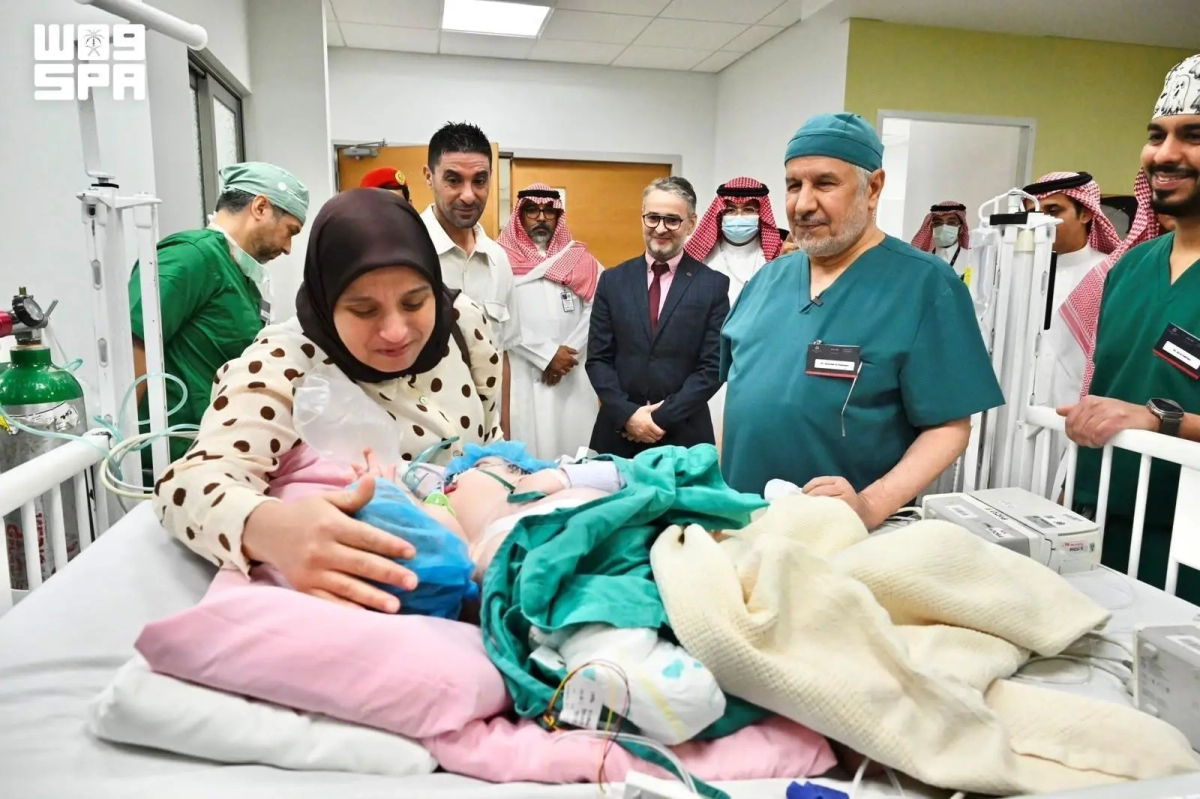
RIYADH — The medical and surgical team of the Saudi Conjoined Twins Program successfully separated 13-month-old Moroccan conjoined twins Saja and Duha on Thursday. The surgical separation was held at King Abdullah Specialist Children’s Hospital in King Abdulaziz Medical City under the Ministry of National Guard in Riyadh. This was in line with the directives of Custodian of the Two Holy Mosques King Salman and Crown Prince and Prime Minister Mohammed bin Salman. Supervisor General of the King Salman Humanitarian Aid and Relief Center (KSrelief) and head of the medical and surgical team Dr. Abdullah Al-Rabeeah led the surgical separation.The twins arrived in the Kingdom on April 24, 2026. The medical team conducted extensive and detailed examinations and held several meetings, determining that the twins were conjoined at the chest and abdomen and shared the membranes surrounding the heart, liver, and intestines. Dr. Al-Rabeeah noted that the surgery was performed in six stages over approximately 10 hours, involving 23 consultants, specialists, nurses, and technical staff. He stated that this is the fourth separation surgery performed for conjoined twins from Morocco and the 73rd case undertaken by the Saudi Conjoined Twins Program, which has cared for 159 sets of twins from 28 countries across five continents since 1990.RIYADH — The medical and surgical team of the Saudi Conjoined Twins Program successfully separated 13-month-old Moroccan conjoined twins Saja and Duha on Thursday. The surgical separation was held at King Abdullah Specialist Children’s Hospital in King Abdulaziz Medical City under the Ministry of National Guard in Riyadh. This was in line with the directives of Custodian of the Two Holy Mosques King Salman and Crown Prince and Prime Minister Mohammed bin Salman. Supervisor General of the King Salman Humanitarian Aid and Relief Center (KSrelief) and head of the medical and surgical team Dr. Abdullah Al-Rabeeah led the surgical separation.The twins arrived in the Kingdom on April 24, 2026. The medical team conducted extensive and detailed examinations and held several meetings, determining that the twins were conjoined at the chest and abdomen and shared the membranes surrounding the heart, liver, and intestines. Dr. Al-Rabeeah noted that the surgery was performed in six stages over approximately 10 hours, involving 23 consultants, specialists, nurses, and technical staff. He stated that this is the fourth separation surgery performed for conjoined twins from Morocco and the 73rd case undertaken by the Saudi Conjoined Twins Program, which has cared for 159 sets of twins from 28 countries across five continents since 1990.
Moroccan conjoined twins separated successfully