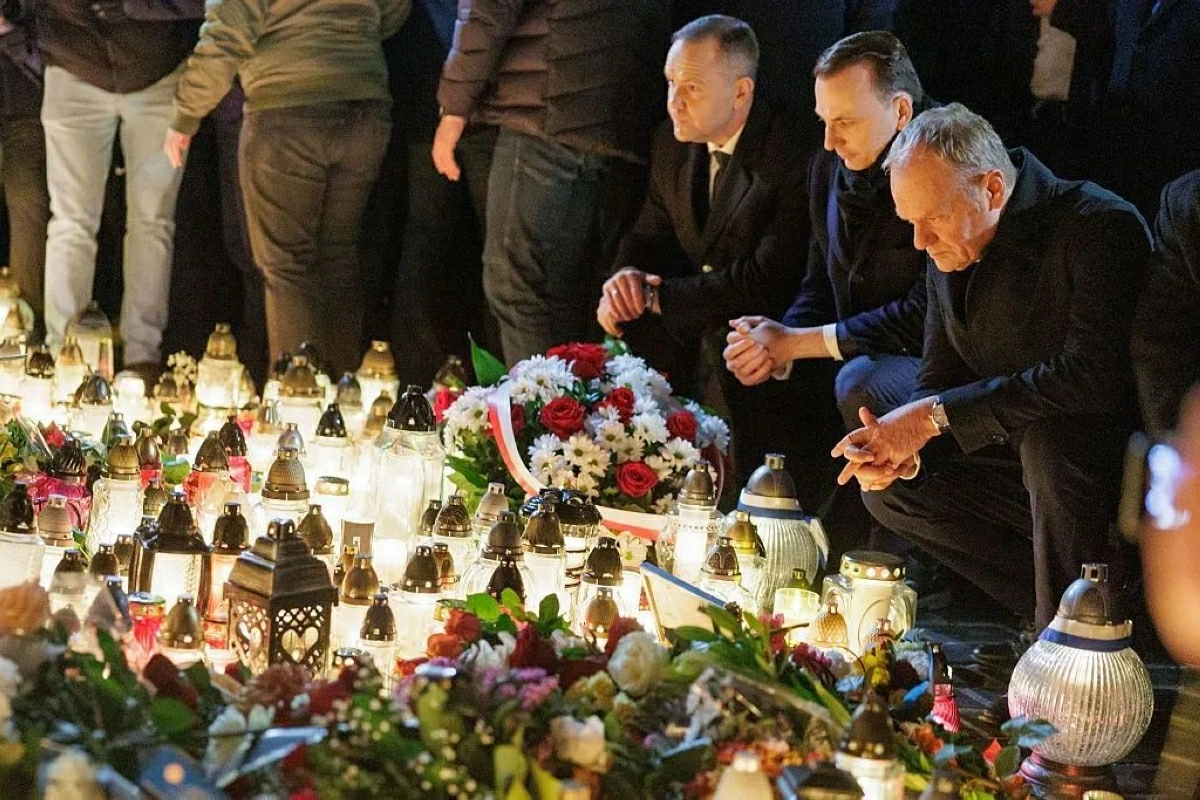

WARSAW — Tens of thousands of people joined a silent march in Kraków on Monday night, led by Poland’s president and prime minister, in tribute to the victims of a mass shooting that shocked the country over the weekend.They set off from the city’s historic market square, where the attack unfolded on Saturday afternoon. Mourners stopped at a flower-covered memorial marking the spot where the gunman opened fire from his car, killing six people and wounding 15 others.Nationalist President Karol Nawrocki and centrist Prime Minister Donald Tusk, bitter political rivals putting on a rare show of unity, led the crowd through the city alongside Kraków’s mayor, Lukasz Gibal, after the country’s deadliest attack in modern times.As they reached the historic Market Square, a bugler played from the tower.Many people were carrying flowers or candles to leave at the shrines that now dot the cobblestones, each one marking a spot where someone died.Fiercely proud of its reputation for safety, Poland has been profoundly shaken by this attack. It has left people struggling to make some kind of sense of what happened.The alleged gunman has been named as 24-year-old Michal Oksinski by local media. Critically injured in a shoot-out with police, he did not regain consciousness and died in hospital early on Monday.Initially, the interior minister claimed that Oksinski was driven by far-right, extremist views. The national prosecutor’s office now says that it is too soon to say he was “inspired” by any ideology.”The minister wanted to win domestic political points. That’s not responsible behavior,” Pawel Musialek of the Jagiellonian University suggests, in a country where politics is highly — and often viciously — polarised.”So far we’ve seen no clear message that this guy was strongly ideological, and that it’s not more like something from the darknet.”There has been no mention of any letter or manifesto that Oksinski left. One neighbor told Polish news site Onet that the 24-year-old was a “bit of a loner” but few who knew him well have spoken publicly.In addition to his electronic devices like his phone, investigators are examining a number of badges that Oksinski had attached to his military-style outfit.The prosecutor’s office says a yellow Gadsden flag with a coiled snake symbol was displayed in his bedroom. “It has various meanings of freedom and rebellion,” a spokesman emphasised. “Not necessarily negative.”It was at Oksinski’s home that the bodies of his parents and sister were discovered.It is alleged that he shot them, before driving some 200 km south to continue the killing in Krakow.The six people killed in the Kraków shooting spree included an Austrian woman and a British man, according to authorities, while the 15 wounded included Austrian, British, German, Portuguese and Russian nationals.The injured were in a “stable” condition on Monday, authorities said.While Oksiński’s motives are unclear, investigators are treating the shooting spree as a terrorist incident. He had no prior criminal record, according to investigators cited by Polish media.WARSAW — Tens of thousands of people joined a silent march in Kraków on Monday night, led by Poland’s president and prime minister, in tribute to the victims of a mass shooting that shocked the country over the weekend.They set off from the city’s historic market square, where the attack unfolded on Saturday afternoon. Mourners stopped at a flower-covered memorial marking the spot where the gunman opened fire from his car, killing six people and wounding 15 others.Nationalist President Karol Nawrocki and centrist Prime Minister Donald Tusk, bitter political rivals putting on a rare show of unity, led the crowd through the city alongside Kraków’s mayor, Lukasz Gibal, after the country’s deadliest attack in modern times.As they reached the historic Market Square, a bugler played from the tower.Many people were carrying flowers or candles to leave at the shrines that now dot the cobblestones, each one marking a spot where someone died.Fiercely proud of its reputation for safety, Poland has been profoundly shaken by this attack. It has left people struggling to make some kind of sense of what happened.The alleged gunman has been named as 24-year-old Michal Oksinski by local media. Critically injured in a shoot-out with police, he did not regain consciousness and died in hospital early on Monday.Initially, the interior minister claimed that Oksinski was driven by far-right, extremist views. The national prosecutor’s office now says that it is too soon to say he was “inspired” by any ideology.”The minister wanted to win domestic political points. That’s not responsible behavior,” Pawel Musialek of the Jagiellonian University suggests, in a country where politics is highly — and often viciously — polarised.”So far we’ve seen no clear message that this guy was strongly ideological, and that it’s not more like something from the darknet.”There has been no mention of any letter or manifesto that Oksinski left. One neighbor told Polish news site Onet that the 24-year-old was a “bit of a loner” but few who knew him well have spoken publicly.In addition to his electronic devices like his phone, investigators are examining a number of badges that Oksinski had attached to his military-style outfit.The prosecutor’s office says a yellow Gadsden flag with a coiled snake symbol was displayed in his bedroom. “It has various meanings of freedom and rebellion,” a spokesman emphasised. “Not necessarily negative.”It was at Oksinski’s home that the bodies of his parents and sister were discovered.It is alleged that he shot them, before driving some 200 km south to continue the killing in Krakow.The six people killed in the Kraków shooting spree included an Austrian woman and a British man, according to authorities, while the 15 wounded included Austrian, British, German, Portuguese and Russian nationals.The injured were in a “stable” condition on Monday, authorities said.While Oksiński’s motives are unclear, investigators are treating the shooting spree as a terrorist incident. He had no prior criminal record, according to investigators cited by Polish media.
Poland’s political rivals join ‘march of silence’ for Kraków shooting victims