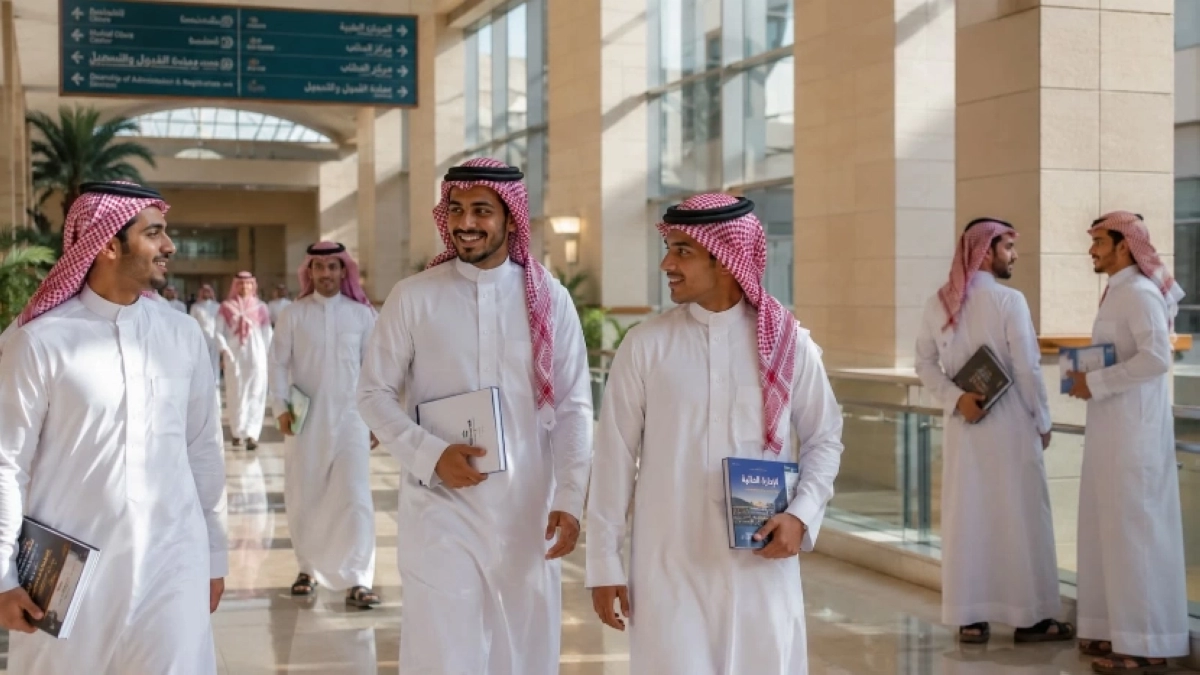

RIYADH — It was revealed in a recent scientific study that Saudi university students spend an average of three hours and 28 minutes per day on social media, with notable differences across academic years. The study, which involved 2,540 male and female students at Saudi public and private universities, was published in the journal BMC Psychology, a Springer Nature publication, on August 10, 2026.According to the study, first-year students reported the highest average, at 3 hours and 49 minutes per day, compared with 3 hours and 22 minutes among third-year students and 3 hours and 19 minutes among fourth-year students. It was found in the study that 42.8 percent of participants fell within the category of low psychological well-being. The average overall psychological well-being score was 52.98 out of 100, a level the researchers classified as borderline and warranting further monitoring.Researchers from Prince Sultan University in Riyadh participated in the study, which sought to assess social isolation, smartphone dependence, social media use, social support, the university environment, psychological well-being, and academic engagement among university students. The researchers distributed the questionnaire to approximately 10,000 students and received 2,540 completed responses, resulting in a response rate of 25.4 percent. Fifth-year students recorded the lowest level of psychological well-being, with an average score of 47.58 out of 100, while first-year students recorded the highest average at 54.41 out of 100. The findings also indicated that first-year students experienced greater levels of social support than second-year students. The findings showed that 72.7 percent of students experienced a moderate level of loneliness and social isolation, while 56.5 percent reported moderate smartphone dependence and 56.4 percent reported moderate levels of social support. Despite these psychological and social challenges, 44 percent of the students demonstrated a high level of academic engagement. The study found no significant differences between male and female students in terms of social isolation, smartphone dependence, or psychological well-being, despite females comprising 60 percent of the sample and males 40 percent. The sample was also almost evenly divided between students at public universities (49.7 percent) and private universities (50.3 percent).Among the study’s key findings was a clear association between greater social isolation and lower psychological well-being, while higher levels of social support were associated with improved well-being. Smartphone reliance did not appear to be a direct factor explaining the decline in psychological health, nor did a supportive university environment demonstrate an independent effect in the statistical model used.Despite the widespread use of smartphones and social media among university students, the researchers found that the psychological and social factors examined in the study accounted for less than one percent of the variation in psychological well-being. This suggests that broader factors related to students’ personal, family, academic, and economic circumstances may play a more significant role.Furthermore, the study found no clear correlation between psychological well-being and academic engagement. Some students maintained high levels of academic engagement despite experiencing indicators of lower psychological well-being.The study sample consisted of students aged 18 to 29, with 60.5 percent between the ages of 18 and 24. Participants represented a wide range of academic disciplines, including medicine, engineering, science, nursing, dentistry, humanities, and business. The study relied on established scientific measures, including the World Health Organization’s Psychological Well-being Index, the UCLA Loneliness Scale, and the Nomophobia Scale, which measures the fear or anxiety associated with being without a mobile phone. Data were collected during September and October 2025. The researchers emphasized that the findings should be interpreted in the context of the sample and data-collection methodology. The study used a convenience sample rather than a random sample and employed a cross-sectional design. Consequently, the findings identify relationships between variables but do not establish direct causal relationships.RIYADH — It was revealed in a recent scientific study that Saudi university students spend an average of three hours and 28 minutes per day on social media, with notable differences across academic years. The study, which involved 2,540 male and female students at Saudi public and private universities, was published in the journal BMC Psychology, a Springer Nature publication, on August 10, 2026.According to the study, first-year students reported the highest average, at 3 hours and 49 minutes per day, compared with 3 hours and 22 minutes among third-year students and 3 hours and 19 minutes among fourth-year students. It was found in the study that 42.8 percent of participants fell within the category of low psychological well-being. The average overall psychological well-being score was 52.98 out of 100, a level the researchers classified as borderline and warranting further monitoring.Researchers from Prince Sultan University in Riyadh participated in the study, which sought to assess social isolation, smartphone dependence, social media use, social support, the university environment, psychological well-being, and academic engagement among university students. The researchers distributed the questionnaire to approximately 10,000 students and received 2,540 completed responses, resulting in a response rate of 25.4 percent. Fifth-year students recorded the lowest level of psychological well-being, with an average score of 47.58 out of 100, while first-year students recorded the highest average at 54.41 out of 100. The findings also indicated that first-year students experienced greater levels of social support than second-year students. The findings showed that 72.7 percent of students experienced a moderate level of loneliness and social isolation, while 56.5 percent reported moderate smartphone dependence and 56.4 percent reported moderate levels of social support. Despite these psychological and social challenges, 44 percent of the students demonstrated a high level of academic engagement. The study found no significant differences between male and female students in terms of social isolation, smartphone dependence, or psychological well-being, despite females comprising 60 percent of the sample and males 40 percent. The sample was also almost evenly divided between students at public universities (49.7 percent) and private universities (50.3 percent).Among the study’s key findings was a clear association between greater social isolation and lower psychological well-being, while higher levels of social support were associated with improved well-being. Smartphone reliance did not appear to be a direct factor explaining the decline in psychological health, nor did a supportive university environment demonstrate an independent effect in the statistical model used.Despite the widespread use of smartphones and social media among university students, the researchers found that the psychological and social factors examined in the study accounted for less than one percent of the variation in psychological well-being. This suggests that broader factors related to students’ personal, family, academic, and economic circumstances may play a more significant role.Furthermore, the study found no clear correlation between psychological well-being and academic engagement. Some students maintained high levels of academic engagement despite experiencing indicators of lower psychological well-being.The study sample consisted of students aged 18 to 29, with 60.5 percent between the ages of 18 and 24. Participants represented a wide range of academic disciplines, including medicine, engineering, science, nursing, dentistry, humanities, and business. The study relied on established scientific measures, including the World Health Organization’s Psychological Well-being Index, the UCLA Loneliness Scale, and the Nomophobia Scale, which measures the fear or anxiety associated with being without a mobile phone. Data were collected during September and October 2025. The researchers emphasized that the findings should be interpreted in the context of the sample and data-collection methodology. The study used a convenience sample rather than a random sample and employed a cross-sectional design. Consequently, the findings identify relationships between variables but do not establish direct causal relationships.
Saudi university students spend 3.5 hours daily on social media; study reveals