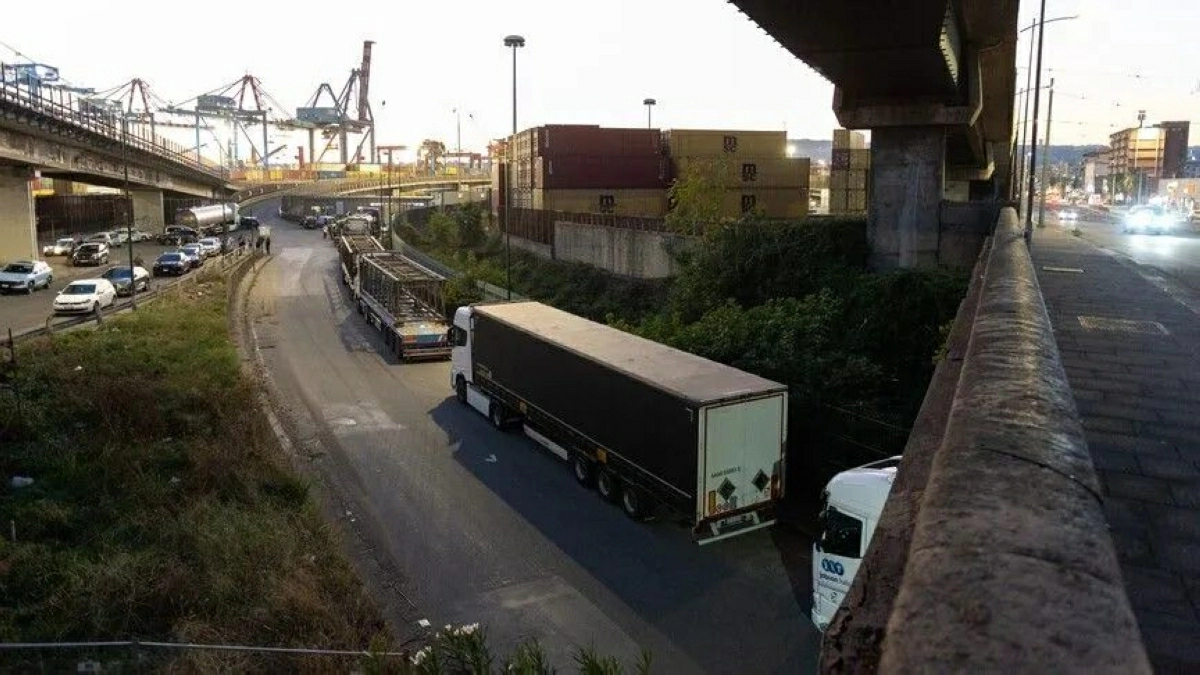
ROME — Truckers’ protests over rising fuel costs spread across southern Italy on Monday as road and port blockades disrupted deliveries and left some supermarket shelves empty, the Italian news agency ANSA reported.Truckers blocked access to Naples’ commercial port, while road blockades and demonstrations also affected Calabria, Basilicata, Puglia and Sicily.The disruption has slowed the distribution of goods, particularly fresh produce, with shortages reported in parts of Campania, Sicily and Calabria.The protests have reportedly affected the collection and delivery of agricultural products, raising concerns among producers about potential losses.Transport Minister Matteo Salvini said he was confident that the government could release delayed funds, hear truckers’ demands and begin dialogue to ease pressure on roads and highways.Farmers and truckers have since last week blockaded ports and major highways to protest high fuel prices triggered by the war in Iran, causing shortages at supermarkets and gas pumps. They say price hikes have chipped away at their slim margins and are demanding a stronger government response.Meanwhile, in cities across northern Italy on Saturday and Sunday, thousands of student demonstrators marched in protest of low wages, high taxes, rising grocery and gas prices and cuts to public funding. A number of the marches turned violent, as groups of masked protesters looted stores, set fires and lobbed projectiles toward the police, who responded with water cannons and tear gas.Prime Minister Giorgia Meloni, who has made law and order a pillar of her government, acknowledged her “great respect” for peaceful protesters in a post on social media on Saturday but condemned the violence: “Protesting is a right. Setting our cities ablaze is not.”She met with government and law officials on Monday to consider harsher penalties for violent protesters.Though the majority of protesters in Milan marched peacefully, clashes with the police led to the arrests of 32 people, most of them minors. The police said 14 officers had been injured, one of whom was hit on the head with a cobblestone. A Milan business association estimated on Monday that the unrest had caused more than one million euros, or about $1.1 million, of damage.In a statement, Giuseppe Sala, the city’s left-wing mayor, called “actions and scenes like those we witnessed on Saturday and Sunday, directed against law enforcement and against public spaces and businesses, intolerable and unjustifiable.”Images and videos of the disorder prompted strong negative reactions across the country. “Unacceptable,” read Monday’s front page of Il Messaggero, one of Italy’s national dailies.But some urged Italians to look past the violence. “Young people are angry,” Marco Bascetta wrote on Saturday in Il Manifesto, Italy’s communist daily. “If a body of water is neglected and choked for decades, it can’t be expected not to overflow.”ROME — Truckers’ protests over rising fuel costs spread across southern Italy on Monday as road and port blockades disrupted deliveries and left some supermarket shelves empty, the Italian news agency ANSA reported.Truckers blocked access to Naples’ commercial port, while road blockades and demonstrations also affected Calabria, Basilicata, Puglia and Sicily.The disruption has slowed the distribution of goods, particularly fresh produce, with shortages reported in parts of Campania, Sicily and Calabria.The protests have reportedly affected the collection and delivery of agricultural products, raising concerns among producers about potential losses.Transport Minister Matteo Salvini said he was confident that the government could release delayed funds, hear truckers’ demands and begin dialogue to ease pressure on roads and highways.Farmers and truckers have since last week blockaded ports and major highways to protest high fuel prices triggered by the war in Iran, causing shortages at supermarkets and gas pumps. They say price hikes have chipped away at their slim margins and are demanding a stronger government response.Meanwhile, in cities across northern Italy on Saturday and Sunday, thousands of student demonstrators marched in protest of low wages, high taxes, rising grocery and gas prices and cuts to public funding. A number of the marches turned violent, as groups of masked protesters looted stores, set fires and lobbed projectiles toward the police, who responded with water cannons and tear gas.Prime Minister Giorgia Meloni, who has made law and order a pillar of her government, acknowledged her “great respect” for peaceful protesters in a post on social media on Saturday but condemned the violence: “Protesting is a right. Setting our cities ablaze is not.”She met with government and law officials on Monday to consider harsher penalties for violent protesters.Though the majority of protesters in Milan marched peacefully, clashes with the police led to the arrests of 32 people, most of them minors. The police said 14 officers had been injured, one of whom was hit on the head with a cobblestone. A Milan business association estimated on Monday that the unrest had caused more than one million euros, or about $1.1 million, of damage.In a statement, Giuseppe Sala, the city’s left-wing mayor, called “actions and scenes like those we witnessed on Saturday and Sunday, directed against law enforcement and against public spaces and businesses, intolerable and unjustifiable.”Images and videos of the disorder prompted strong negative reactions across the country. “Unacceptable,” read Monday’s front page of Il Messaggero, one of Italy’s national dailies.But some urged Italians to look past the violence. “Young people are angry,” Marco Bascetta wrote on Saturday in Il Manifesto, Italy’s communist daily. “If a body of water is neglected and choked for decades, it can’t be expected not to overflow.”
Supermarket supplies disrupted as truckers’ protests spread across southern Italy